





Picking the right print on demand partner shapes how your business runs. It affects your profit on each sale, how fast orders reach buyers, and how good your products look. With so many options out there, the choice can take time. This guide makes it easier. We ranked the top print on demand companies 2026 has to offer and compared 17 platforms side by side. You will see how each one handles costs, product range, print quality, and shipping, so you can pick the best fit for your store.
Key Takeaways
- Each of the 17 companies leads in a different area, so pick by product line.
- In-house printers give steadier quality, while network printers offer more products and lower prices.
- Companies printing near buyers cut delivery times for stores selling in several countries.
- PrintKK suits new stores, with 1,300+ products and no minimum order.
What a Print on Demand Company Does for Sellers
Nothing Gets Made Until Someone Buys
Say a customer orders a mug with a cat on it. The order goes to the print company, and that one mug gets printed. Not fifty, just the one. There's no pile of leftover stock to worry about, so a seller can try ten new designs this week and only pay for the ones that actually sell.
A Catalog Is Already Waiting
POD companies keep a catalog of blank products, anything from basic tees to phone cases. Pick a product, drop a design on it, and list it. Most companies also make mockups, those product photos that show the design on a shirt or mug, so a listing can go up the same day. Still, order one sample before going big. Colors on a screen often look brighter than they do in real life.
The Package Goes Straight to the Buyer
Once the store is hooked up, orders slide over to the printer without anyone lifting a finger. The company prints the item, boxes it up, and mails it out. A tracking number lands back in the store so the buyer can follow along. Some companies will even use custom packaging, so the box looks like it came from the seller's brand and not a warehouse.
The 17 Top Print on Demand Companies in 2026
1. PrintKK
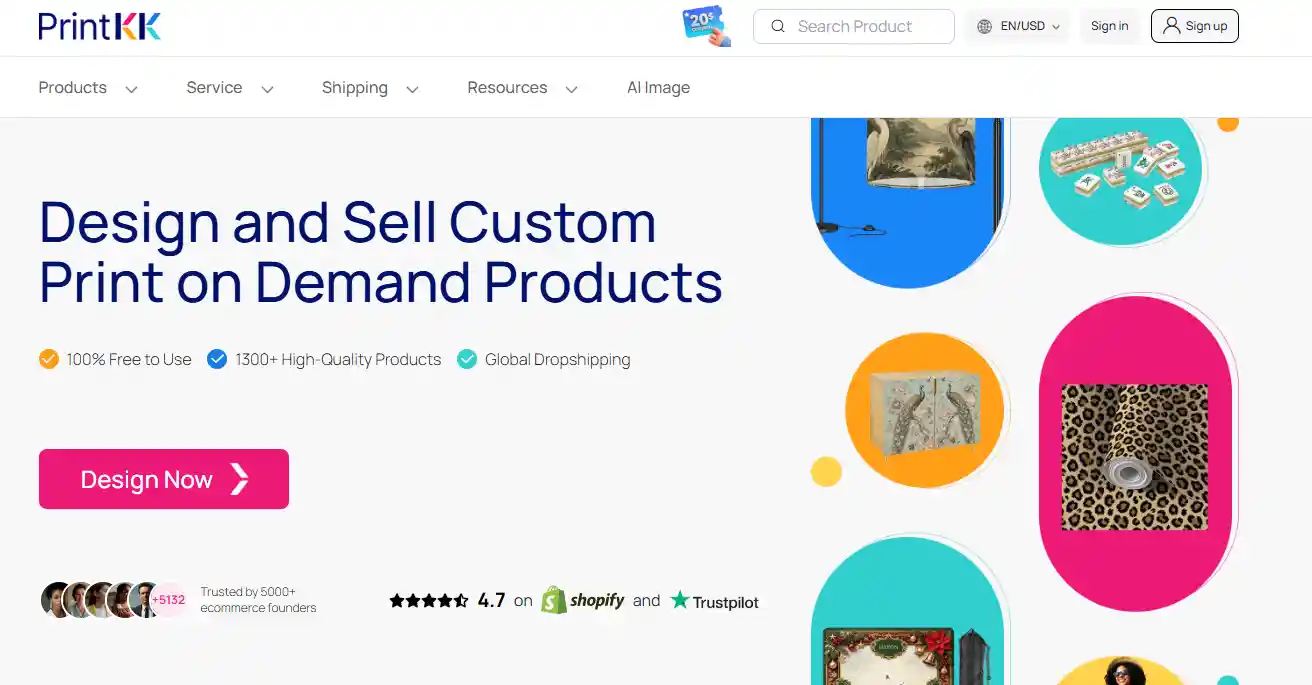
PrintKK carries 1,300+ products with no minimum order, so one sale is enough to start. For sellers who can't draw, the built-in AI design tool turns a rough idea into a print-ready file. Custom packaging and hang tags help orders arrive looking like a real brand sent them, and some parts of the US get free shipping.
Pros:
- AI tool cuts down design time
- Custom packaging and hang tags for a branded look
Cons:
- Free shipping covers only part of the US
Best for: Sellers who want a branded store without paying much upfront.
2. CustomCat
CustomCat is a Detroit-based company best known for apparel, though its catalog also covers items like mugs and wall art. The shirt selection runs deep, with plenty of styles and colors and kids' sizes too. A store could build its whole apparel line here without adding a second supplier. US orders get made and shipped fast, a plus for shops with mostly American buyers. Not every color comes in every style, though, so check before listing.
Pros:
- Deep apparel catalog
- Fast turnaround on US orders
Cons:
- International orders cost more to ship since production is in the US
Best for: Apparel stores selling mostly in the US.
3. SPOD
SPOD is Spreadshirt's print on demand service. Spreadshirt has printed custom clothes for years, and SPOD is best known for short production times. That matters a lot in December, when a late package can turn into a refund request. Quick turnaround also helps with trend designs that won't sell a month from now.
Pros:
- Orders leave production quickly
- Connects to Shopify
Cons:
- Fewer packaging and branding choices than some suppliers
Best for: Simple apparel stores where speed counts more than custom packaging.
4. Merchize
Merchize makes apparel and gift items for sellers who handle a lot of orders. It's a better match once a store has a few proven designs and wants to push them harder. A supplier set up for volume can take some daily order work off a seller's hands. Compare its base prices with the current supplier's before making a switch.
Pros:
- Set up for big order counts
- Covers apparel and gifts
Cons:
- Less payoff for stores with only a few orders a week
Best for: Established sellers ready to scale their best sellers.
5. Gelato
Gelato prints each order close to where the buyer lives. A customer in Germany gets a print made in Europe. A customer in Texas gets one made in the US. Shorter trips mean faster delivery, and overseas buyers are less likely to face customs fees at the door. For a store with buyers in lots of countries, one supplier can cover most of them.
Pros:
- Local production in many countries
- Strong wall art and poster lineup
Cons:
- Quality can differ between local partners
Best for: Art and decor sellers with buyers around the world.
6. Gearment
Gearment is a US printer that mostly uses DTG, short for direct-to-garment. The ink goes into the fabric instead of sitting on top, and the print feels soft. Designs with lots of colors or fine lines come out well, especially on cotton. Order a sample shirt first to see how the colors look on real fabric.
Pros:
- Sharp results on colorful, detailed art
- US production for faster local delivery
Cons:
- DTG colors can look duller on dark or polyester fabric
Best for: US stores selling bright, detailed graphic tees.
7. Apliiq
Apliiq is a Los Angeles company known for private label clothing. Sellers can add their own woven labels, and a hoodie stops looking like a plain blank. Buyers notice details like that. A brand that looks the part can also charge more per piece.
Pros:
- Strong tools for building a clothing brand
- Streetwear-style cuts and blanks
Cons:
- Branded pieces cost more per item than basic blanks
Best for: Streetwear brands that can charge premium prices.
8. Gooten
Gooten sends orders to a network of partner factories. Its catalog leans toward home items like blankets and pillows. These sell well as gifts, and sales often pick up around the holidays. An apparel store can also use them to offer matching sets, say a hoodie and a throw blanket with the same design.
Pros:
- Good home decor range
- Easy add-on for apparel stores
Cons:
- Delivery times vary by partner
Best for: Stores adding cozy home goods to their lineup.
9. merchOne
Wall art usually sells for more than a T-shirt, and merchOne has been making it for a long time. The company focuses on canvas and framed prints. It started in Europe and now also has fulfillment centers in the US, so orders can be made closer to buyers in both regions. Offering one design in a few sizes and frame styles gives shoppers more ways to buy.
Pros:
- Long track record with wall art
- Production in both Europe and the US
Cons:
- Little to offer beyond wall art
Best for: Wall art sellers with buyers in Europe and the US.
10. Printful
Printful makes most orders in its own facilities in North America and Europe and works with partners in only a few countries. Because it controls most of its production, a shirt ordered in March tends to look like one ordered in June. Sellers can answer questions about color and fit without guessing. Printful also offers inside labels and pack-ins for a branded unboxing.
Pros:
- Steady quality from order to order
- Lots of branding options
Cons:
- Base prices sit above budget suppliers
Best for: Brands that compete on quality and unboxing, not price.
11. Printify
Sellers who like options tend to land on Printify. It doesn't print anything itself. Instead, it hands each order to one of many partner factories, and every partner sets its own price and shipping time. That keeps costs low. It also means the same hoodie can come back looking a bit different depending on who made it. Ordering a sample from two partners and laying them side by side settles the question fast.
Pros:
- Huge catalog
- Paid plan lowers base prices
Cons:
- Finding the right partner takes a few test orders
Best for: Testing lots of products on a tight budget.
12. Prodigi
Prodigi focuses on high-end art prints, including giclée prints made with long-lasting inks. Its labs sit in several countries, and orders go to the one nearest the buyer. A print doesn't have to cross an ocean to arrive. Giclée prints keep fine detail and deep color for years, and that quality supports gallery-style prices.
Pros:
- Top print quality for fine art
- Global lab network
Cons:
- Premium prints cost more to make
Best for: Photographers and illustrators selling premium prints.
13. Fourthwall
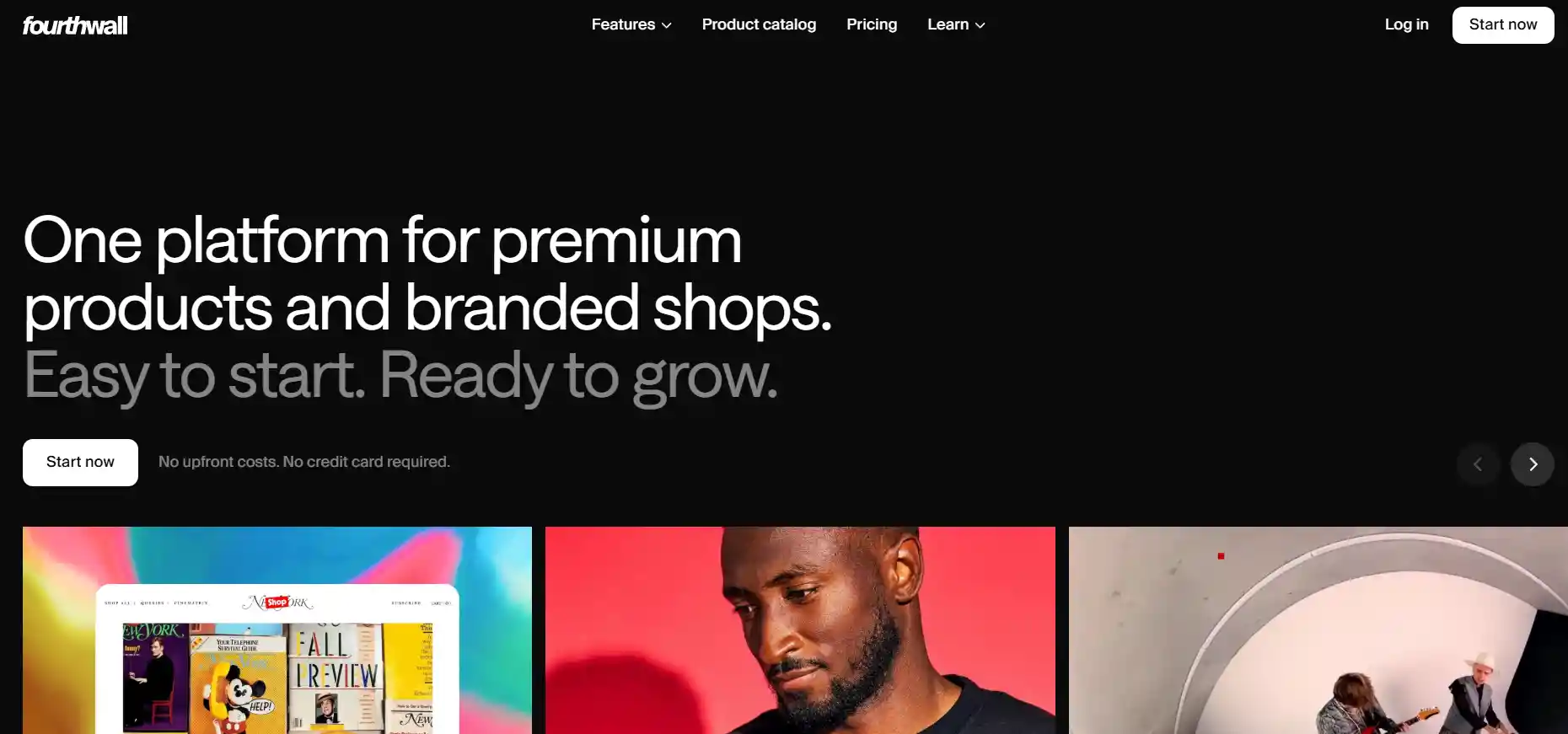
Fourthwall is made for creators who sell to their fans. Creators get a ready-made shop they can link from a channel or bio, with no separate store to build. Fans can join memberships too, a second way to earn on top of merch. It works best for creators who already have an audience.
Pros:
- All-in-one creator shop
- Earning options beyond merch
Cons:
- Stores that sell mainly through marketplaces get less out of it
Best for: YouTubers and streamers who want merch and fan support in one place.
14. ShineOn
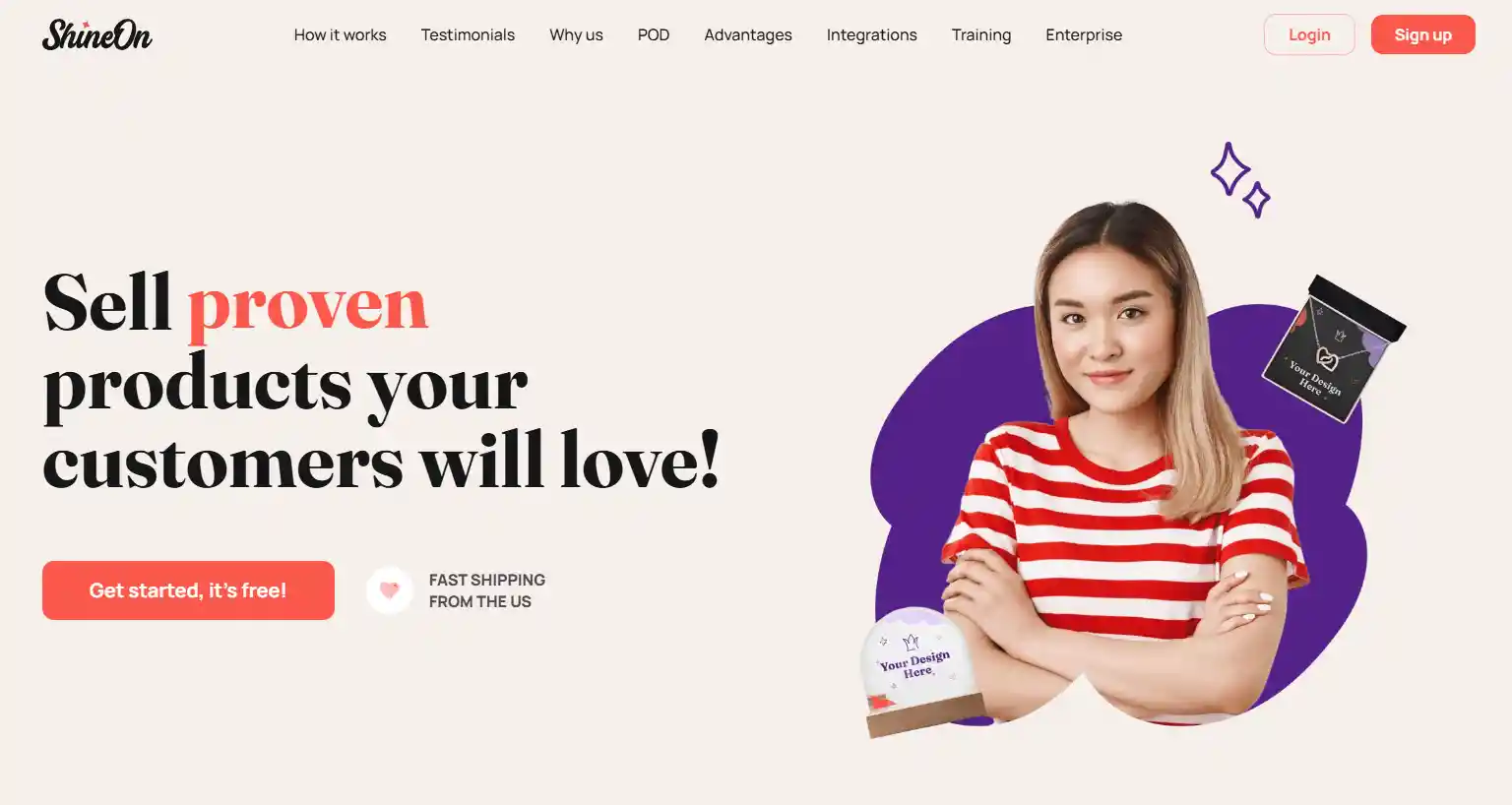
ShineOn makes custom jewelry, like necklaces with printed or engraved pendants. Many pieces ship in a gift box with a message card, ready for a birthday or holiday right away. A name or photo on the pendant turns a simple necklace into a personal gift. Jewelry is small and light, and shipping stays cheap.
Pros:
- Gift-ready packaging
- Low shipping weight
Cons:
- Stores selling other products need a second supplier
Best for: Gift shops selling personalized jewelry.
15. Lulu
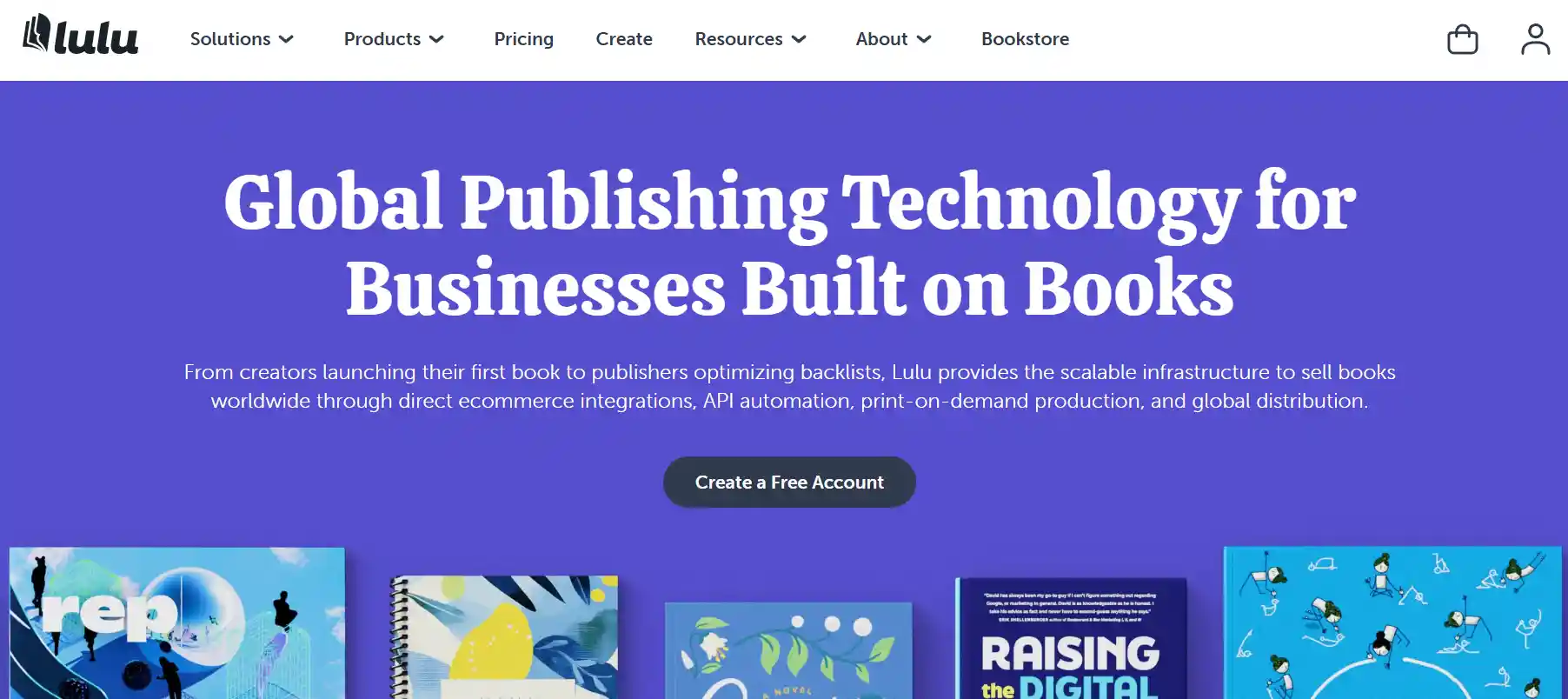
Lulu prints books on demand, from novels to planners. Each copy gets printed after it sells, and nobody ends up with a box of unsold books in the closet. Lulu has worked with self-published authors for many years and also handles journals people use every day. Page size and binding affect how a book looks and feels. Reading Lulu's file guidelines before uploading can save a reprint.
Pros:
- No upfront book stock
- Connects with Shopify
Cons:
- File setup takes more care than a T-shirt design
Best for: Authors and creators selling books, journals, or planners.
16. QPMN
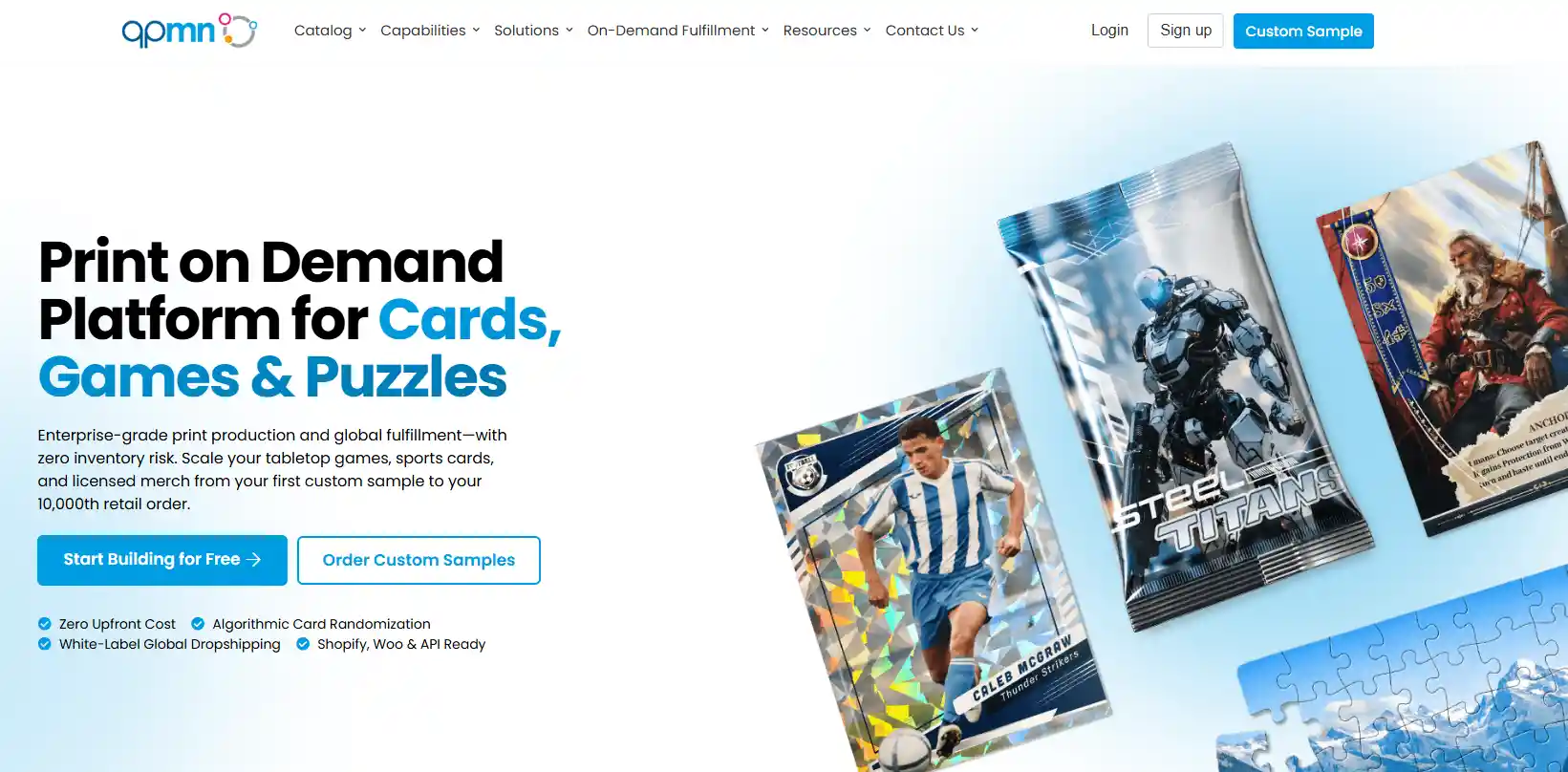
Game designers can skip the big print run with QPMN, which prints custom trading cards and card games on demand. Cards tend to sell in bundles or full sets, and that pushes up the value of each order. The card stock and finish change how a deck feels and shuffles, so a sample deck is worth ordering before launch day.
Pros:
- Built for cards and games
- No large upfront print run
Cons:
- Card files need more prep than a basic design
Best for: Game designers launching their own sets.
17. Teelaunch
Teelaunch carries products that don't show up in every POD catalog, like doormats and garden flags. Fewer sellers offer them, and a good design has a better chance of getting noticed on a marketplace. They also fit seasonal ideas, like a holiday doormat or a team flag. That gives sellers something new to launch at different times of the year.
Pros:
- Unusual products that stand out
- Good for testing niche ideas
Cons:
- Production times differ by product
Best for: Sellers chasing less crowded niches.
How to Choose the Right Print on Demand Company
Match the Catalog to the Product Line
Start with the products, not the company. A store built around wall art needs a printer with good frames and paper. A streetwear brand cares more about heavy hoodies and a good fit. Look for a company that does the store's main product really well, not one that does a little of everything. Extra products can come later, even from a second supplier.
Confirm the Store Integration
A great printer is no use if it can't plug into the store. Make sure it works with the platform the store runs on, like Shopify or Etsy, before spending time on anything else. Some companies connect directly, while others need a third-party app in the middle, and that app may come with its own fee. Placing one test order is the quickest way to see whether orders move over smoothly.
Compare Base Cost and Shipping Cost
The base cost is what the company charges to make the item. It's the number everyone looks at first, and it can fool people. A shirt that's $2 cheaper to make can end up costing more once shipping gets added, especially when the buyer lives far from the factory. Price out a full order to where most buyers are, including the cost of a second item in the same box.
Check Production Speed and Location
Production time and shipping time are two different clocks. The first covers how long printing takes, and the second covers the trip to the buyer. Add them together and that's the real wait. A printer close to the customer cuts the second clock short, and a company with factories in both Europe and the US keeps delivery times even for a store that sells in both.
Pick In-House or Network Production
Some companies print everything in their own facilities. Others pass orders to a group of partner printers. In-house production tends to give steadier quality, since the same team handles every order. A network usually offers more products and lower prices, but results can change from one partner to the next. Stores that sell on consistency lean one way, and stores that sell on price and choice lean the other.
Check How Problems Get Fixed
Sooner or later, an order will show up with a smudged print or a crushed box. What matters is what happens next. Read each company's reprint policy before signing up, and check who pays and how many days there are to report a problem. Then send the support team a simple question and see how long a reply takes. That first response is a pretty good preview of how things will go when a real problem hits.
Run the Profit Math Before Committing
Here's a quick example. Say a shirt sells for $25, and the print company charges $12 to make it and $5 to ship it. That leaves $8, but it isn't profit yet. Payment fees and marketplace fees come out next, then any ad spend. What's left after all that is the real profit.
Run this math for the top two or three companies on the shortlist, using real prices from their sites. The one with the lowest base cost isn't always the one that leaves the most money behind.
High-Margin POD Niches to Watch in 2026
Custom Games and Playing Cards
Custom games might be the most overlooked corner of print on demand. A one-of-a-kind game is a gift nobody can grab off a store shelf, and that makes it easier to charge more than a basic tee. A few product ideas that work well:
- Mahjong tiles: A set printed with a family name or a favorite color scheme is something most game shops don't carry.
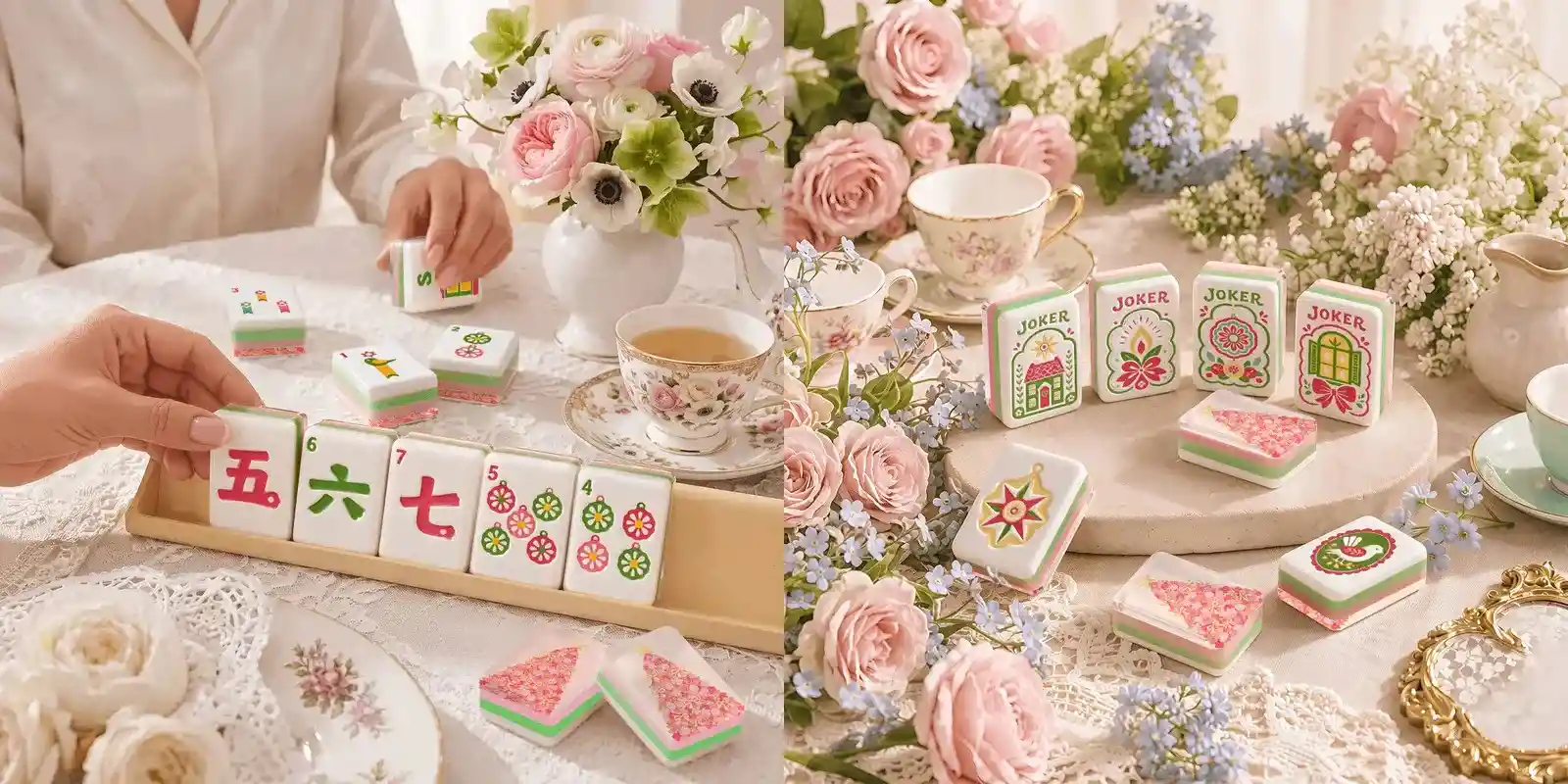
Custom Printed on Demand Scandi Folk Art Christmas Mahjong Tiles - Mahjong - PrintKK
- Playing cards: A deck with a family photo on every card makes a memorable gift for birthdays and reunions.

Print On Demand Double-Sided Playing Cards with Tin Case - PrintKK
- Jigsaw puzzles: A puzzle made from a wedding or vacation picture turns a favorite memory into something to do together.
Custom Wooden Jigsaw Puzzles 300 pcs (Vertical) - Print on Demand Fulfillment - PrintKK
Acrylic and Wall Art
Wall art leaves more room on price than apparel, and a frame widens that gap. Acrylic pushes it further. An acrylic block or print looks glossy and modern, and photos pop on it in a way paper can't quite match. Canvas still does well for living rooms and nurseries. One design can be sold in a few sizes and materials, so a single piece of art can reach buyers with very different budgets.
Custom Canvas Prints Wall Art (4:5) - Print-On-Demand - PrintKK
Pet Products
Plenty of pet owners will buy almost anything with their own dog's face on it. That's what makes this niche such a good fit for personalization. Some easy starting points:
- Pet beds and bowls: Printing the pet's name on them makes each one feel made for that animal.
Print on Demand Space Capsule Pet Bed - Pet Furniture - PrintKK
- Bandanas: They're light, cheap to ship, and easy to refresh with a new design for each holiday.

Print On Demand Velcro Dog Bandana - PrintKK
- Photo gifts: A blanket or pillow with a cat's portrait sells well as a gift for friends who love their pets.

Print on Demand PE Dog Flying Disc - Pet Accessories - PrintKK
How to Connect Social Shops to a POD Company
Set Up the Connection
Most POD companies keep their social shop links on an integrations page inside the dashboard. PrintKK, for one, hooks right into TikTok Shop, and orders from the app head straight into production. Setup goes roughly like this:
- Find the integrations page and pick the platform.
- Sign in to the shop and approve the link.
- Send over one product, then look at it in the shop to make sure the photos and price came through right.
- Buy it with a test order and see if it shows up at the printer.
Match Production Time to Shipping Rules
Social platforms usually give sellers a handling time, which is the window between someone paying and the package leaving. They also keep score on who ships late. The rules shift by platform and region, so pull up the seller center and get the real numbers before listing. Then line them up against how long the POD company takes to print. If printing eats most of that window, park the product for now.
Keep Tracking in Sync
People who buy on social apps check on their package. A lot. Once the order ships, the tracking number should pop up in the shop without anyone touching it. Watch the first few orders closely, because a missing number can make an order look late when it's already on a truck. If numbers aren't coming through, fix it right away, before ten more orders stack up behind it.
Get Ready Before a Video Takes Off
Nobody knows which video will blow up. When one does, a quiet shop can get a flood of orders in a single afternoon. Before posting, check the printer's production times and whether they slow down around the holidays. One easy trick is to put the same design on a second product, like a hoodie next to the tee. If one runs low, buyers still have something to add to cart.
Read More:
- How Much Does Print on Demand Cost: A Beginner's Guide
- How to Start a Print on Demand Business: Complete Guide
Start Your Print on Demand Business With PrintKK
Starting small is the smartest way to test what sells, and PrintKK is set up for exactly that. There's no minimum order, so a single design can go live on any of its 1,300+ products without buying stock first. The AI design tool turns rough ideas into print-ready files, and orders from major e-commerce platforms like Etsy flow straight into production. Custom packaging and hang tags make each order look like it came from a real brand, and some parts of the US get free shipping. Put one design out there this week and let the sales show what to make next.
Expert Tips
The right platform depends on what you sell and where you sell it. Some companies keep base costs low. Others offer more products or faster shipping. This list of the top print on demand companies 2026 gives you a clear starting point. Compare a few that match your goals. Order samples to check quality yourself. Then pick the one that fits your budget and your store. With the right partner in place, you can focus on design and growth.