





Choosing between dropshipping vs affiliate marketing is one of the first big calls anyone makes when trying to earn online. Both models are real, both can pay off in 2026, and both work in very different ways.
One asks for money upfront to move fast. The other asks for time and patience to build something that lasts.
This guide walks you through how each one actually works, where the money really comes from, and how to pick the path that fits your situation.
Key Takeaways
- Dropshipping trades money for speed; affiliate marketing trades time for lower risk.
- Dropshipping gross margins look healthy, but ad spend and fees often shrink net margins to single digits.
- Affiliate income takes months to appear, but organic traffic keeps earning for years.
- Dropshippers carry full product liability as the seller of record; affiliates do not.
- PrintKK supports both paths with print-on-demand fulfillment and an affiliate program.
What Is Dropshipping?
Dropshipping means selling products without ever touching them. When an order comes in, the supplier ships it straight to the customer. The store owner handles the storefront and marketing; the supplier handles the boxes.
The common trap is thinking dropshipping is the business. It isn't — it's just how products get to buyers. What gets sold and who it's sold to is the actual business.
Two stores can both dropship and end up in completely different places, because one picked a tight niche and the other just uploaded whatever was trending that week.
The real tradeoff is control. Skipping warehouse rent and upfront inventory sounds great, but the supplier's shipping times and quality become the store's problem — and when something goes wrong, the store owner is the one explaining it to the customer.

What Is Affiliate Marketing?
Affiliate marketing means earning a commission for sending customers to someone else's product. A blogger reviews a camera, drops a special link, and every sale through that link pays them a cut. No inventory, no shipping, no support tickets — just the referral.
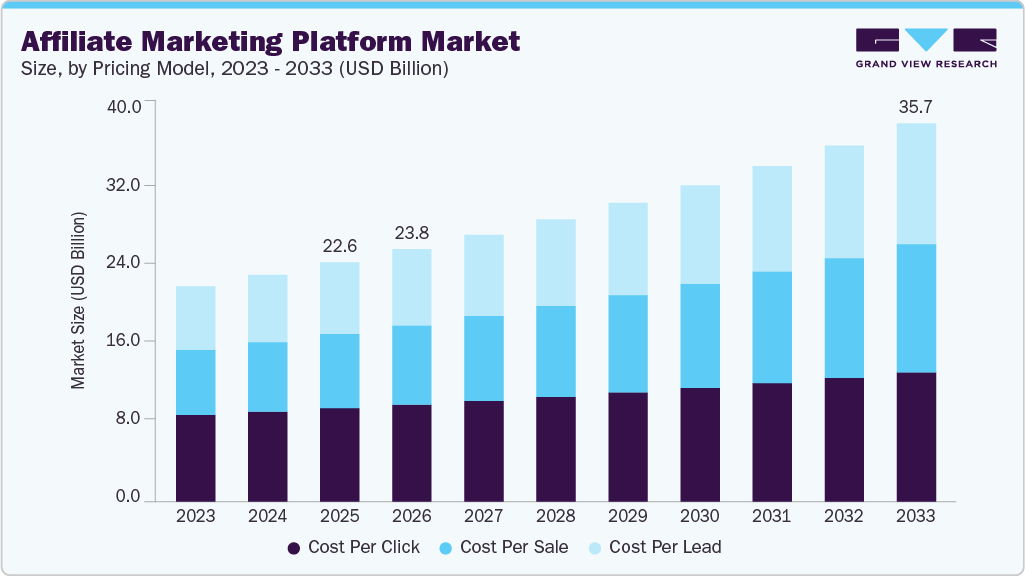
It's a bigger space than most people think. The global affiliate marketing platform market was worth USD 22.6 billion in 2025 and is expected to reach USD 35.7 billion by 2033, at a 5.9% CAGR. A lot of that comes from brands moving budget out of paid ads and into creators whose audiences actually listen to them.
The catch: affiliate income depends on traffic and trust. A link on a page nobody reads earns nothing. A link shoved at an audience that smells a cash grab earns worse than nothing — it eats away at why they showed up in the first place.
Most affiliates who make real money spent years building the thing that came before the links: a niche site, a channel, a newsletter. Without that, the commission rate barely matters.
Dropshipping vs Affiliate Marketing: 8 Key Differences
1. Ease of Starting
Dropshipping gets a store live in a weekend — Shopify theme, a few products imported, ad account ready. The first sale can happen the same day the ads go live, as long as the budget's there.
Affiliate marketing is even cheaper to launch, since a WordPress site or a YouTube channel costs almost nothing. But the first sale usually takes months, because it depends on traffic that hasn't been built yet.
2. Startup and Ongoing Costs
Dropshipping keeps burning cash across several fronts:
- Ad spend on Meta or TikTok, usually the biggest line item by far
- Return handling and payment processing fees, which quietly eat into every order
- Shopify app stack — one app for reviews, one for upsells, one for email — cheap alone, but the monthly total creeps into the hundreds fast
Affiliate marketing has much thinner monthly bills — hosting, an email tool like Klaviyo or Beehiiv, SEO software like Ahrefs or Semrush.
Someone could run the whole operation for under $200 a month. The real cost isn't money though. It's the months of unpaid work before any traffic shows up, which is where most people quit.
3. Skills Required
Dropshipping is a paid-media job at its core:
- Writing ad hooks and testing creatives
- Watching return on ad spend and killing losing ads fast
- Tightening landing pages for conversion
- Handling chargebacks and supplier issues in the background
Affiliate marketing is a content and SEO job:
- Search intent research and long-form writing
- Backlink outreach that takes weeks per link
- Email newsletter sequences to convert readers into buyers
The dropshipping loop is fast — a bad ad dies in 48 hours. The affiliate loop is slow — a page might take six months to rank, so mistakes take much longer to notice and fix.
4. Profit Margins
Dropshipping margins look better on the pricing page than in the bank account. Gross margins of 20–40% are common, but ad spend, returns, and processing fees usually shrink net margins to single digits.
Affiliate marketing skips most of those costs — no inventory, no refunds, no ad spend if the traffic is organic. That's why a $50 commission on an affiliate sale often puts more money in the pocket than a $50 dropshipping order.

5. Cash Flow and Payouts
Dropshippers pay suppliers before payment processors release the customer's money. New merchants often get hit with holds — a slice of each sale withheld for weeks or months as protection against refunds.
When a campaign scales fast, this becomes a real squeeze: the ad bill is due Friday, the supplier wants payment before Monday shipping, and last week's sales are still locked up at Stripe. That gap gets floated on personal credit more often than anyone admits.
Affiliate marketing has the opposite problem, and it's a smaller one. Networks pay on Net-30 or Net-60 terms, sometimes longer, so the money isn't fast. But there are no suppliers to pay and no ad bills due before the check clears, so slow payouts don't turn into a cash squeeze.
The tradeoff is clawbacks: if a buyer refunds a month later, that commission gets pulled back from the next payout.
6. Legal Liability
Dropshippers are the seller of record, which triggers a stack of obligations:
- Product liability — if a lithium battery catches fire or a beauty product causes a reaction, the store owner is on the hook, not the AliExpress supplier
- LLC and insurance — most serious operators eventually register an LLC and buy general liability coverage
- Tax compliance — US sales tax across multiple states, or EU VAT registration
Affiliates carry basically no product liability. The rules that matter are FTC disclosure guidelines (clear affiliate labels above the fold) and GDPR cookie consent — annoying paperwork, but nothing that ends in a lawsuit over a defective product.
7. Platform and Policy Risk
Dropshipping can go dark overnight from a Meta or TikTok ad ban, a Stripe suspension over chargeback rates, or a customs rule change. The whole business runs through accounts that another company controls, and none of those companies owe an explanation before pulling the plug.
Affiliate sites face a different set of threats: Google core updates that tank rankings, AI answer boxes eating into informational clicks, and programs cutting commissions without warning — Amazon Associates famously slashed rates in 2020.
Tracking is fragile too: affiliate links get stripped by ad blockers, privacy extensions, and iOS updates, so a chunk of earned commissions quietly disappears before they're ever counted.
8. Long-Term Value
Dropshipping stores trade at lower valuation multiples because traffic depends on ad spend that can vanish overnight.
The exception is operators who've built private-label products with real brand equity — those exit closer to content-site prices because the buyer is getting an actual brand, not just a Shopify theme wired to AliExpress.
Content sites with real domain authority — years of backlinks, ranked pages, a mailing list — sell as assets on marketplaces like Empire Flippers or Flippa. Buyers pay more because the traffic keeps coming even if the owner stops working on it for a few months.
Read More:
- Best 30+ Free Dropshipping Websites to Build an Online Store
- Comprehensive Comparison: Print on Demand vs Affiliate Marketing
How to Choose for Your Business: Dropshipping vs Affiliate
1. Match It to How You Like Working
The best model is usually the one that fits how someone actually likes spending their day:
- Prefers testing, tweaking, moving fast → dropshipping runs on short feedback loops and daily decisions about ad spend
- Prefers writing, researching, building over time → affiliate marketing runs on content that takes weeks to make and months to rank
Both can be learned, but the day-to-day work is very different. It's worth being honest about which one sounds like a chore and which one sounds fine.
2. Dropshipping Pros and Cons
Dropshipping has real strengths and real weaknesses. Worth looking at both before deciding:
- Pros — fast setup, quick feedback on what's working, no inventory to hold, and scale that can happen within weeks if a product hits
- Cons — thin net margins after ads and fees, cash flow squeezed by payment holds, and heavy exposure to ad platform bans
The pattern most people notice is that dropshipping is a money-and-attention game. It moves fast in both directions, so the ceiling is high but so is the daily stress.

3. Affiliate Marketing Pros and Cons
Affiliate marketing has a different shape of pros and cons:
- Pros — very low startup cost, no product liability, high net margin on organic traffic, and content that can keep earning for years after it's published
- Cons — months (sometimes a year) before meaningful income, heavy dependence on Google or platform algorithms, tracking losses from ad blockers and privacy tools, and commission cuts that can happen without warning
Affiliate flips the equation. Costs stay low, but so does income for a long stretch — and success depends on channels nobody in the business owns.
4. Match It to What You Already Have
It also helps to look at what's already there before picking:
- Existing audience (newsletter, YouTube, TikTok) → affiliate marketing turns that attention into income without needing to ship anything
- Existing supplier contacts or a product idea → dropshipping lets those ideas get tested without ordering inventory
- Neither → either model works as a starting point; dropshipping moves faster with a small ad budget, affiliate is cheaper without one
Either way, picking one and giving it six months of steady effort tends to work better than splitting attention across both.
How to Run Dropshipping and Affiliate Marketing Together
Running both at once isn't for beginners — the earlier advice to pick one still applies for the first six months. But once one side is stable and generating traffic or revenue, the other can be layered on top without splitting focus.
Fund Ad Testing With Affiliate Income
Testing dropshipping products means burning through ad budget before a winner shows up. Affiliate commissions from a related content site can cover that testing cost, so the store gets built without dipping into savings.
A niche blog earning a few hundred a month in affiliate commissions can bankroll the Meta or TikTok tests that surface a winning product.
Once that product hits, the store scales on its own revenue — and the affiliate site keeps earning in the background, funding the next test or a second store.
Content Site + Print-on-Demand
A content site can carry both models at the same time. Affiliate links stay the main earner — reviews, comparisons, and buying guides that rank in search. On the side, a small print-on-demand shop lets the site sell branded merch (mugs, tees, phone cases) to readers who already like the brand.
Platforms like PrintKK print and ship each order after it's placed, so there's no inventory to manage. This works best when the site already has a clear identity readers connect with, because merch sells to fans, not to cold traffic.

Custom Color Changing Mug (11oz) (Made in USA) - Print-On-Demand - PrintKK
Start Dropshipping and Affiliate Marketing With PrintKK
Both models come together nicely on a single platform when it comes to print-on-demand — and PrintKK is set up to support either path, or both at once if the fit is right.
Dropshipping With PrintKK
PrintKK covers a wide product range under one account — mugs, phone cases, custom apparel, and photo puzzles all sit in the same catalog, so operators can test different niches without moving to a new platform each time.
Stores connect directly to Shopify, Etsy, and other major channels, and orders route through automatically once a customer checks out. This suits people who want to build a branded storefront but would rather skip the warehouse, packing tape, and shipping labels.
Affiliate Marketing With PrintKK
For readers who already have traffic — a blog, a niche audience, a review channel — PrintKK also runs an affiliate program. Program terms, commission structure, and payout details are available on the affiliate program page for anyone who wants to look at the specifics.
This path suits people who'd rather monetize an existing audience than run a store, since there's nothing to set up on the fulfillment side.
Expert Tips
The dropshipping vs affiliate marketing debate isn't really about which one is better. It's about which one fits your situation right now.
Both models have made people real money in 2026, and both have made people quit within a year. The difference usually comes down to whether you play to your own strengths or fight against them.
Start with the one that matches what you already have, commit to it long enough to see real results, and stay open to combining both once the first one is working.
FAQs
Which Is More Profitable, Dropshipping or Affiliate Marketing?
It depends on execution. Dropshipping can generate bigger revenue and build brand equity that sells at a premium on exit. Affiliate marketing keeps a higher share per sale but needs steady traffic to add up.
Which Has Lower Startup Costs, Dropshipping or Affiliate Marketing?
Affiliate marketing has the lower entry cost — a domain and hosting cover most of what's needed. Dropshipping requires a store, apps, and an ad budget, which adds up faster in the first month but also produces sales much sooner.
How Long Does It Take to Make Money With Dropshipping or Affiliate Marketing?
Dropshipping can produce sales within days once ads go live. Affiliate marketing usually takes six months to a year, since it depends on content ranking in search or an audience growing over time.
Is Dropshipping a Real Business Model or Just a Fulfillment Method?
Dropshipping is a fulfillment method, but the business around it is real. Product choice, marketing, and customer experience decide whether it works — the shipping setup is just one piece of the whole operation.
Is Affiliate Marketing More Passive Than Dropshipping?
Affiliate marketing feels more passive once content is ranking, since old articles can earn for years. But the upfront work is heavy and payoff is slow. Dropshipping needs daily attention on ads and orders, though that also means faster feedback and quicker income.



 Global Shipping